READ THE WATER
Battleship strategy
A good shot starts with what you already know.
You cannot see the opposing fleet, but every hit, miss, and sunk ship changes your choices. These examples use this game's 10 × 10 board, no-touch rule, and 10-ship fleet. They help you make deliberate decisions; they do not guarantee a win.
01 / BEFORE THE FIRST SHOT
Make your layout hard to repeat.
Vary the position and orientation of your ships between Matches. If a friend recognizes the same corner ship every time, they can start there next time. Use both horizontal and vertical placements, while leaving the required gap between ships.
There is no universally safest edge, corner, or centre. An edge placement has fewer surrounding cells, but it is also a familiar place to search. Choose different legal layouts rather than treating one arrangement as a shield. Auto place is a useful way to try fresh positions, not a promise of an unbeatable fleet.
02 / WHEN THE BOARD IS UNKNOWN
Search systematically, then adapt.
Keep track of the cells you have tried. In an open area, spreading early shots can help you look for longer ships without repeatedly testing the same small patch. Once you find a hit, use that information before continuing a broad search.
The single-cell catch
Every straight ship of length two or more crosses both colours of a checkerboard. Searching one colour can therefore find those longer ships.
But this fleet includes four single-cell ships. They can sit entirely on the other colour. A checkerboard alone cannot guarantee finding the whole fleet. Include other available cells, especially when only single-cell ships remain.
As ships sink, use the Fleet status to track the lengths still afloat. A remaining length-three ship needs three consecutive legal cells; an isolated unknown cell cannot hold it. If a single-cell ship is still afloat, that same isolated cell may be worth a shot. Exclude cells already known empty and keep the remaining ship lengths in mind.
03 / WHEN YOU FIND A HIT
Follow the line.
If a hit does not sink the ship, try an available cell directly above, below, left, or right of it on your next turn. Ships are straight, so a diagonal cell cannot continue the same ship. A miss rules out that direction; another hit can reveal its orientation.
If D5 is a Miss, continue from the other end at G5. If G5 is already a Miss, try D5 instead. Do not spend shots beside E5 or F5 once the vertical line is established. Keep extending along the line until the ship sinks, using the remaining lengths to judge what can still fit.
A Hit still ends your turn. Plan the next target while the opponent acts. Selecting a coordinate and pressing Fire are separate actions, so check the displayed coordinate before committing your Shot.
04 / AFTER A SHIP SINKS
Let the empty border do the work.
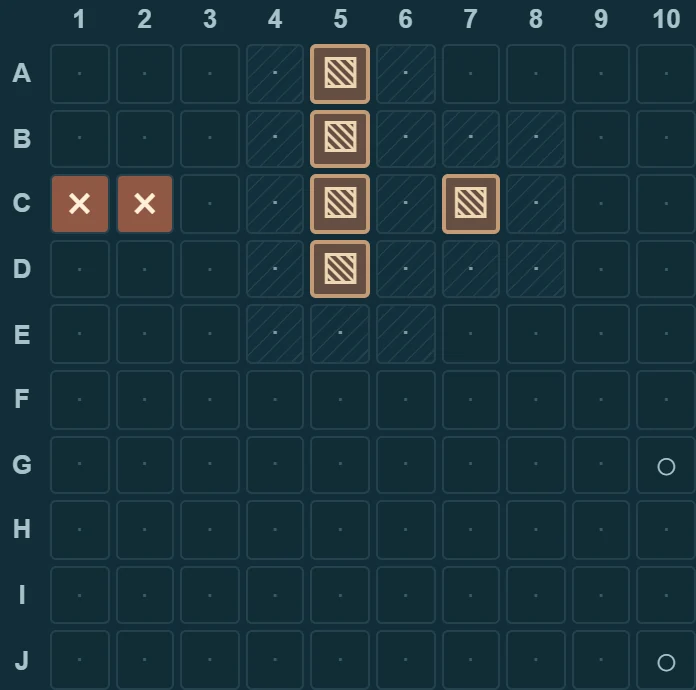
Separate ships cannot touch the sunk ship, even diagonally. Its surrounding border is therefore empty. The game marks those cells for you and prevents shots into them.
Use that cleared space to narrow the remaining search. Do not confuse the entire border around a sunk ship with the cells beside an unsunk Hit: some neighboring cells may still be part of that same ship.
05 / THE LAST FEW SHIPS
Reassess what is still possible.
When you have no unfinished hit to follow, check which ship lengths remain. Look for spaces that can hold those ships without crossing misses, deduced empty cells, or a sunk ship's border. If only single-cell ships remain, search the remaining unknown cells on both checkerboard colours.
Neither a long empty run nor an isolated gap proves a ship is there. They are candidates. Keep updating your plan from confirmed shots, not guesses about a hidden fleet.
A simple turn checklist
- Is there an unfinished hit to follow?
- Which ship lengths are still afloat?
- Is the candidate cell still unknown and compatible with those lengths?
- Have I checked the coordinate before pressing Fire?
Practise one idea at a time in a computer Match. Both the 2D board and 3D ocean show the same rules and shot information; choose the view you find easiest to read. For placement controls and the full rules, read How to play.